Advanced sorting technology crowns loose tomato production line
While traditional loose tomatoes are less common on supermarket shelves, they remain highly sought after in processing and quick-service restaurants (QSRs). Specifically, there is a growing demand for loose, stemless tomatoes due to their ease of use. Van den Belt Tomaten is responding to this demand by investing in advanced technology. They were the first in the Netherlands to acquire the Ferrari among optical sorting machines from the Italian Sorma Group. This investment is the culmination of their work and a significant optimization step for the cultivation of loose round tomatoes and Intense slicing tomatoes.
Van den Belt Tomato Nursery, run by brothers Klaas and Jacob van den Belt, is located in IJsselmuiden. From the very beginning, they have been sharply focused on market demand. By continuously responding to customer demand and investing in modern technology and cultivation methods, Van den Belt now positions itself as a major player in various segments of the tomato market.
The family business has experienced impressive growth, reaching 28 hectares, serving both national and international markets in all these segments. Van den Belt is a member of the GMO-certified growers' cooperative Oxin Growers UA. This partnership enables them to supply customers both domestically and internationally. Oxin Growers handles the agreements between buyers and growers, ensuring short logistics lines.
Van den Belt specializes in traditional loose tomatoes in addition to vine tomatoes. Van den Belt supplies a very wide range of customers, from local produce specialists to supermarkets throughout Europe. Klaas: "Loose tomatoes offer remarkable versatility, suitable for a variety of culinary applications, from fresh consumption to use in sauces and other preparations. This versatility makes loose tomatoes attractive to a wide range of customers, from home cooks to professional chefs." Specifically, there is a growing demand for loose, stemless tomatoes due to their ease of use. Processing companies and quick-service restaurants (QSRs) are among the main buyers of these tomatoes.
Fast and careful sorting.
To serve these markets even better, Van den Belt, in addition to optimizing the cultivation process, was the first in the Netherlands to invest in Sorma Group's advanced Optical Sorting Machine with the Hyper Vision system. This allows them to meet the high and diverse quality requirements in the loose tomato market. The advanced sorting technology can quickly and carefully sort loose tomatoes: with and without the stem, by color intensity, defects, and, thanks to near-infrared technology, also by ripeness. All this at a speed of 20 tons per hour, ensuring that tomatoes reach customers as soon as possible after harvest.
Loose tomatoes as a premium product.
Loose tomatoes lack the visual freshness signal of the stem, which is why they are often viewed as a commodity. Nothing could be further from the truth, explains grower Klaas. A great deal of care is devoted to the cultivation and, in particular, the picking process of loose tomatoes. This also justifies the investment in the state-of-the-art sorter. It can ensure that each loose tomato receives a specific destination. "Because the machine maps the harvest so quickly and accurately, we can respond very effectively to demand and specific quality requirements, thus successfully marketing the entire harvest. The United Kingdom, for example, demands the finer sizes, while distant destinations require unripe tomatoes that ripen further during transport," says Klaas.
After harvesting, the loose tomatoes are transported from the greenhouse to the sorting machine via a water chute. To prevent quality loss, the tomatoes must be dried and sorted as quickly as possible upon arrival. The optical sorting machine can process up to 20 tons of tomatoes per hour, double the capacity of the previous machine. This means the production lines now run more efficiently and staff can be redeployed. Klaas: "Thanks to the new machine, we can not only scale up our production but also reduce our labor costs by working more efficiently. This is crucial at a time when finding qualified personnel is a challenge."
Crownless:
When it comes to loose tomatoes, Van den Belt's customers prefer to have as much of the crown removed as possible. Over the years, customers have become less appreciative of the crown. Processors don't want to encounter any crowns at all in the automated mechanical cutting processes, and certainly not in the final product. Packers are less strict; they will still accept a single tomato with a crown due to its perceived freshness, but even there, they prefer to keep the crowns off the tomato because the hard tips of the crown can damage the fruit and thus reduce shelf life. As many crowns as possible are removed during harvesting, but the new sorter ensures that any tomatoes with crowns that slip through are still removed.
Sorting Guarantee:
The optical sorting system helps Van den Belt deliver tomatoes of guaranteed quality to their final destination, even after multi-day transport. This doesn't mean only perfect tomatoes roll off the conveyor belt. Although the cultivation process is highly controlled and optimized, tomatoes remain a natural product and must be operated within a certain bandwidth. At each harvest point, the easy-to-use dashboard provides insight into harvest variations and allows the sorter to be easily adjusted if necessary. "Sorma's Optical Sorter is equipped with the most advanced technologies to guarantee the quality and efficiency of the sorting process. The system ensures that even the smallest defects and over-ripe areas, invisible to the naked eye, can be detected," explains Evert-Jan Wassink of Sorma Benelux. "But sorting products always involves finding a compromise. We continuously train the computer in what is acceptable and what is not, with the goal of preserving as much product as possible."
This article previously appeared in issue 7, 38th year of Primeur. See www.agfprimeur.nl.
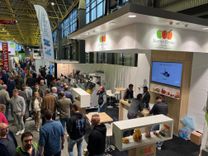
Interpom beurs Kortrijk (Belgium); coorporation between Sorma Benelux and Sormaf

SAY GOODBYE TO CLIP - SORMACLIPLESS

Increasing demand for well-strapped sturdy pallets
